
Arrest Warrants in Lunenburg County
An arrest warrant is judicial process that lets an officer take a person into custody. Virginia Code § 19.2-72 lays out the probable-cause procedure behind it. There is no self-service web form here. A judicial officer reviews a complaint and its supporting facts under the statute. In a Lunenburg County case, the court level and the agency serving the paper can differ, so the clerk can locate the case file while the Sheriff or the investigating police agency holds service details. That division of labor is normal, and knowing it saves you a trip to the wrong window.
Lunenburg County Arrest Warrant Probable Cause
Virginia law spells out a complaint process and a sworn examination in the circumstances set out in § 19.2-72. A judicial officer then weighs whether the facts meet the legal standard. That review stays inside the court. Nothing in it establishes guilt, and the details of an individual investigative file are not public material. For Lunenburg County readers, the Sheriff page offers general law-enforcement contact, but the sheriff posts no public arrest-warrant roster. Read Virginia Code § 19.2-72 for the full issuance framework.
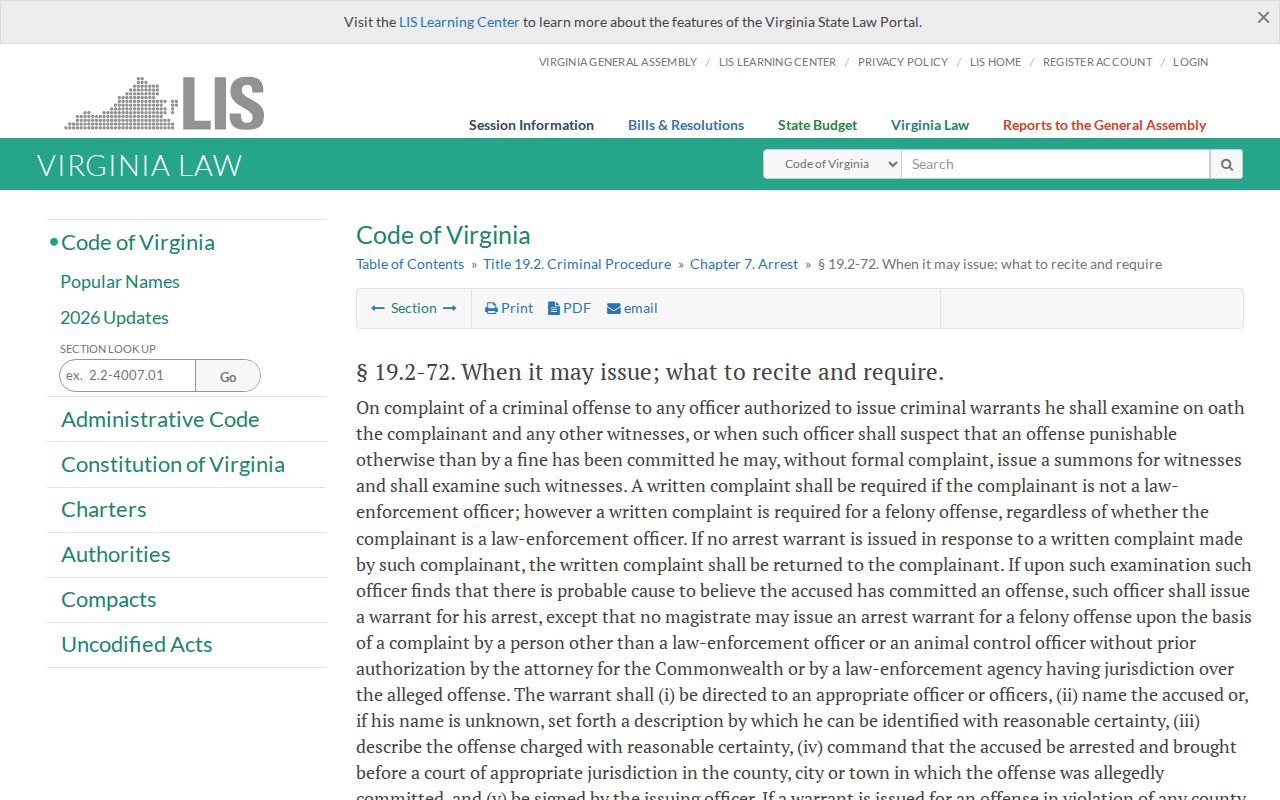
The link goes to a Lunenburg County statute, not a form. It is a rule of process, not an application or public warrant list.
What a Lunenburg County Arrest Warrant Contains
Lunenburg County publishes no public arrest-warrant listing. A court process document itself may name the issuing court, the case number, the process type, the charge, the issue date, and return information. Public OCIS results show only a subset of that. Sealed or investigative material can be restricted. This field outline is educational.
| Issuing court | Identify the court controlling the case and ask its clerk. |
|---|---|
| Process type | Use the exact label, such as arrest warrant, capias, or summons. |
| Charge and code | Read the official court paper; do not recast an allegation as a finding. |
| Issue and return | Dates or service information may be held by the court or executing agency. |
| Status and release | Ask the issuing court or counsel; do not infer an active status from OCIS. |
Lunenburg County Arrest Warrant Field Guide
Virginia's DC-338 is a search-warrant affidavit, not a form for checking arrest-warrant status. Its fields cover an applicant, the place or items involved, probable-cause facts, an oath, and related search authority. A separate form, DC-308, deals with real-time location data. Neither one lists people with arrest warrants. What they do show is the line between search process and arrest process, which is worth knowing before you guess at what a paper means. They are not a private-investigation checklist, and neither is evidence that any named person has a warrant. The official DC-338 PDF is a blank form, and Virginia Courts lists the real-time location form in its criminal forms collection.
How Lunenburg County Arrest Warrants Are Served
Virginia Code § 19.2-76 governs execution and return. The court that issues process, the agency that investigated, and the officer who serves it may all be different offices. Lunenburg County records point to the County Sheriff, town police, a Virginia State Police context, and magistrate services, but no single agency serves every piece of process. The official court or law-enforcement record controls those details. When a paper or docket raises a concern, ask the clerk which office can confirm the return and the current status. Virginia Code § 19.2-76 explains execution and return of process in full.
Lunenburg County Arrest Warrant Service Routes
Local roles are spread across several offices in Lunenburg County. The Circuit Clerk keeps felony and indictment records. The combined clerk handles General District traffic and misdemeanor matters. Magistrates perform issuing and release functions, and the Sheriff's Office serves as the public law-enforcement contact. Town police may also handle local process within their authority. The office holding a docket may not hold the return of service, so ask which office has the specific record rather than assuming the Sheriff, court, or jail holds every part of the file.
| Office | Public role | Route |
|---|---|---|
| Circuit Clerk | Circuit criminal cases and indictments | (434) 696-2132 |
| Combined GDC/JDR clerk | Traffic, misdemeanor, preliminary, and JDR matters | (434) 696-5508 |
| Sheriff’s Office | Local law-enforcement procedure | (434) 696-4452, non-emergency |
Arrest Warrant vs Summons vs Bench Warrant
An arrest warrant follows a probable-cause issuance process. A summons orders or notifies a person to appear. A bench warrant is common speech for court process after a missed obligation, though Virginia records may use capias or another term instead. The label matters less than the substance. Ask the clerk to identify the process rather than relying on a third-party page, because the underlying charge, issuing court, and required appearance can differ.
| Process | Purpose | What to confirm |
|---|---|---|
| Arrest warrant | Authorizes arrest under the process | Issuing court, service, current status |
| Summons | Directs a person to appear | Court date and response instructions |
| Bench warrant or capias | May follow a missed court duty or another statutory event | Exact docket label and next court action |
A Search Warrant Is Different
A search warrant authorizes a search of a place, person, item, or specified data. That is not the same authority as an arrest warrant. The DC-338 and DC-308 forms both relate to search authority, covering probable-cause facts and the scope of the search. Do not use a search-warrant form to infer that a Lunenburg County resident has an arrest warrant. Ask the issuing court or counsel about a specific matter, and leave sealed affidavit details alone.
What to Do If There Is a Warrant for You
Start by preserving the citation, summons, or case paper and identifying its court. Search OCIS only as a case locator. Then call the Circuit Clerk or combined clerk in Lunenburg County and ask what the record actually shows. The Sheriff's general non-emergency line can explain current procedure, though the office page posts no walk-in surrender instructions or bond window. Counsel earns their fee when arrest risk, multiple cases, or an unclear process are in play, since a lawyer can confirm the case and coordinate a lawful appearance. Serving a warrant does not close the case. Skip the commercial search results too. Arriving at an office based only on an online claim is a good way to waste a day.
Important: Contact the issuing clerk and consider counsel before appearing; current surrender and bond instructions were not published by local offices.
Keep written proof of any recall, release term, or new court date in Lunenburg County. Paper beats memory here. A payment or bond release can settle one issue while the case itself stays open, so the file's order decides your next move.
Confirming Lunenburg County Arrest Warrant Process
Think an active warrant might carry your name? Ask the Lunenburg County clerk for the court, the case number, and the exact process label. Then ask which agency handles service or appearance questions. The Sheriff's published non-emergency line covers procedure, not legal advice. Emergencies go to 911. Remember that a blank search result is not statewide clearance; sealed records, some circuit cases, and JDR matters may sit outside the public system. Get your answer from the office that controls the case, then file it with the case papers.